Juvenile Court Adoption

Adoption

North Carolina Legal Options for Kinship Caregivers


When Child Welfare IS Involved

Adoption is a legal process that creates a parent-child relationship between people who are not parent and child by birth. Once a child is adopted, that child has the same legal rights as a child born to the family, and the adoptive parent has the same legal duties as a birthparent to care for and raise the child. The relationship changes from grandparent/grandchild (or aunt/niece, cousin/cousin, etc.) to parent/child.

Once a child is in foster care, adoption is one of the options the Department of Social Services (DSS) considers to provide the child with a permanent family if they cannot return home. Before a child can be adopted, they must be “legally free.” This can happen if both parents voluntarily give up their parental rights. It may be possible for the child’s parents to do a Designated Relinquishment, where they agree to give up their parental rights only if grandparents or other kin adopt. 

If the parents will not voluntarily give up their rights, DSS requests the Juvenile Court judge to Terminate Parental Rights, commonly called “TPR.” TPR means that the parent permanently loses their right to make decisions for the child and their ability to change or regain custody.

Any family who exits foster care through reunification, guardianship, custody, kinship care or adoption is eligible to participate in the NC DHHS Success Coach program. These services are voluntary and intended to provide ongoing support as families navigate building or rebuilding their relationships after foster care or post-adoption.  A Success Coach is a specialized social worker who works alongside families to assist them in identifying their most pressing needs, developing a tailored success plan, and connecting them to additional community-based resources. Services are ultimately decided on by the family and can include parenting support, crisis prevention, case management, respite, help navigating the behavioral health system, and assistance with basic needs such as employment, food security, housing, educatin and building a reliable support system.

If I Adopt Through Juvenile Court…

What Decisions Can I Make for the Child?

Yes, you have full rights as the parent.

You are the parent, and you decide whom the child can visit, how often, and where. Although all legal rights and duties between the child and birth parents end, it is possible for a relationship between them to continue. Arrangements can be made between you, the birth parent, and the child to continue a relationship if you choose. This is called “open adoption.” You determine what this relationship looks like.

Open Adoption

Yes, you have full rights as the parent.

Yes, with a Juvenile Court Adoption you are allowed to name another caretaker to care for the child in case you die.

Tipsheet: Planning for the What-Ifs

What Financial Supports Are Available?

You may be eligible to receive Adoption Assistance, which are monthly payments that can be equal to the foster parent monthly payments. The amount is based on the age of the child and the child’s specific special needs. Children who have been in foster care, have “special needs,” or are considered more difficult to place are eligible for this financial support. Most children in foster care will qualify for adoption assistance.

Find More Information: Adoption Assistance

No, the child welfare agency does not pay for childcare. However, childcare may be available as a public benefit in your county. Check with your county DSS office.

Find Your County’s DHHS Office

Yes, if the child qualifies to receive the benefit.

Programs for Grandfamilies & Kinship Families

Yes, if your family qualifies to receive the benefit.

NC DHHS Assistance Programs

The Temporary Assistance to Needy Families (TANF) program, known as Work First in NC, is designed to provide financial assistance to low-income families while also helping them become self-sufficient.

You can only apply for the family grant; the child-only TANF is unavailable.

Family Grants: The State considers the kinship caregiver’s income for family TANF (Work First) grants.

Since these grants are designed to address the needs of the children and their caregivers, these payments are generally larger than child-only grants. Note that people raising a child but not biologically related to the child (such as godparent, neighbor, friend, etc.) are not eligible to include the child when applying for family Work First payments.

Apply at your local DHHS Office

Yes, the child will qualify for social security benefits as a “dependent child” when you die based on your individual work records.

Find Out More At ssa.gov

SSI provides monthly cash payments to help meet the basic needs of children who have a physical or mental disability or are blind. If you care for a child or teenager with a disability and have limited income, savings, or other resources, your child may be eligible for SSI.

Children under age 18 can get a Supplemental Security Income (SSI) cash payment if they meet Social Security’s definition of disability for children and there are limited income and resources in the household.

After the adoption, the family’s income will be considered, which may change how much money the child receives in SSI.

Find Out More At ssa.gov

Are There Any Additional Services Available?

The courts will process the adoption because this is a legal action. After the adoption is finalized, neither the court nor the Department of Social Services (DSS) is involved.

(for example, daycare, transportation assistance to appointments, scheduling appointments, etc.)

No, but adoption assistance monthly payments can cover the cost. In addition to monthly financial assistance, you are eligible for post-adoption support services, including a peer support network, referrals to services, parenting programs, counseling services, and crisis intervention. The Department of Social Services in your county is responsible for providing post-adoption services.

The child will be treated the same as a birth child. You can put the child on your health insurance policy if your policy allows you to do so for a birth child. The child may also be eligible for Medicaid.

Medicaid provides coverage for many healthcare expenses for low-income children and adults, including visits to the doctor, checkups, screenings, prescriptions, and hospitalization.

You can apply for Medicaid on behalf of the children living with you. Medicaid does not have open enrollment periods, so you can apply at any time of the year.

Several programs are available for youth who were adopted after being in foster care. These services can include tuition, books, and room/board for college or post-secondary education, living expenses, childcare, etc. For support understanding FAFSA, visit gksnetwork.org.

NC Reach Financial aid for undergraduates in NC public universities or community colleges:

  • Available to youth who have aged out of foster care at age 18
  • Available to youth who were adopted from foster care on or after their 12th birthday
  • Available to youth who exited foster care to a guardianship home through the Kinship Guardianship Assistance Program (KinGAP)

Education and Training Voucher Program (ETV) Provides funding for school-related expenses for youth:

  • Who were in foster care on or after their 17th birthday
  • Who were adopted from foster care after their 16th birthday
  • Who entered into a guardianship placement from foster care on or after their 16th birthday

John H. Chafee Program Provides funding to assist youth in foster care and young adults formerly in foster care with services and financial assistance to promote their transition to adulthood.

  • Available to youth in foster care and young adults who aged out of foster care.
  • Available to youth who, after age 16, left foster care for kinship guardianship or adoption.
  • Available to youth who experienced foster care after age 14.

SaySo A statewide association of youth aged 14-24 who are, or have been, in the out-of-home care system in North Carolina.

This program offers extensive information for youth and family on services available for transitioning into adulthood.

PDF: Know Your Options

You are the parent of the child after the adoption and are eligible to receive all available child tax credits.

You are eligible for the Federal Adoption Tax Credit for each child adopted, which reduces the federal income tax you must pay. It is a credit rather than a deduction, meaning it is a dollar-for-dollar reduction of your total federal tax liability. This amount varies by year, but it is usually around $15,000.

Federal Adoption Tax Credit

Federal Adoption Tax Credit

If you adopt your loved one, you are eligible for the Federal Adoption Tax Credit for each child adopted, which reduces the federal income tax you must pay. It is a credit rather than a deduction, meaning it is a dollar-for-dollar reduction of your total federal tax liability. This amount varies by year (find current rate), but it is usually around $15,000. Find more information here.

Advantages vs. Disadvantages of a Juvenile Court Adoption

Advantages

  • Once the adoption is finalized, the child’s parents cannot regain custody. It is permanent. This can be seen as both an advantage and a disadvantage.
  • Adoption financial assistance and post-adoption support services are available until the child is 18. College tuition or post-high school training programs may be provided.
  • You are eligible for the Federal Adoption Tax Credit for each child adopted, which reduces the federal income tax you must pay. It is a credit rather than a deduction, meaning it is a dollar-for-dollar reduction of your total tax liability. It is usually in the range of $15,000 per child.
  • The child can inherit from you if you die without a will and receive social security survivor’s benefits. 
  • Most employer-based health insurance policies allow children to be added to your health insurance coverage, including adopted children, plus the child will be eligible to stay on Medicaid.
  • You can decide who the child will be raised by if you die. 

Disadvantages

  • Adoption requires terminating the child’s parents’ parental rights. It can be painful to acknowledge that the child’s parent will not be able to parent in the future. However, you can still maintain a relationship with the child’s parents, with you dictating the terms based on what you think is in the child’s best interest. 
  • You must establish appropriate boundaries with the child’s birth parents that are in the child’s best interest. If you become the child’s guardian rather than adopting, the guardianship order usually specifies what the parents can and can’t do. With adoption, you are going to be responsible for creating those boundaries. 

Tips
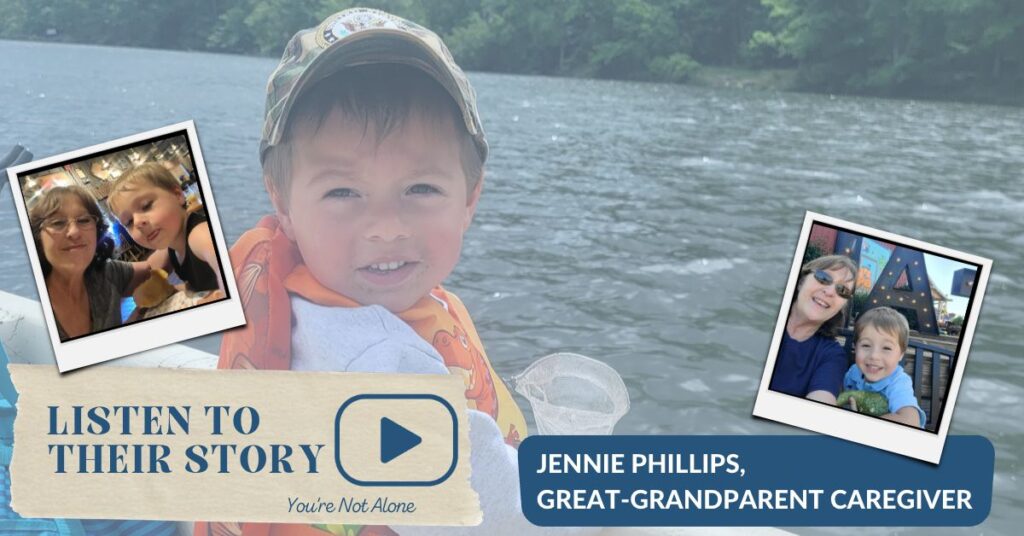
Jennie Phillips, Great-grandparent caregiver. Listen to their story, you are not alone.

*Not Intended as Legal Advice