

Resource Library
Prenatal Substance Exposure Workshop
Prenatal Substance Exposure
Based on extensive research, the US government estimates that 10-11% of all children born in the US have been impacted by prenatal alcohol or drug exposure.* The rate of prenatal exposure for kids in the foster care system is significantly higher. [Source: US DHHS, Substance Abuse and Mental Health Services Administration]
Earlier symptoms often continue into older ages.
Infancy
- Small (height, weight, head circumference)
- Low muscle tone (floppy)
- High muscle tone (rigid)
- Poor sleep patterns
- Difficult to soothe
- Feeding problems/poor sucking
- Sensory issues (easily overstimulated or under-responsive)
- Difficulty adapting to new things/situations
- Increased risk for insecure parent/child attachment
Toddler/Preschool
- Gross and fine motor delays
- Language delays
- Cognitive delays
- Emotional dysregulation
- Poor balance
- Memory problems
- Impulsivity/Hyperactivity
- Sensory issues (often seeking sensory stimulation)
- Higher incidence of dental concerns
Elementary School
- Developmental disparities (at age level for some skills & well below age level for others)
- Able to do age-appropriate skills one day but not the next (“on days/off days”)
- Attention/hyperactivity-poor risk assessment
- Poor social skills
- Emotional dysregulation
- Executive functioning deficits (usually becoming more apparent in 2nd – 4th grade)
- Trouble with generalizing (applying information from one setting to another setting)
- Struggle with abstract thinking (forming links and associations) & predicting outcomes (difficulty with math)
- Not understanding cause and effect; consequences of actions
- Lacking in “common sense”
- Repeats same mistakes
- Difficulty with organization
- Slow task completion
- Lying
- Stealing
Adolescence
- Slower processing speed
- Struggle with predicting consequences (out of the ordinary)
- Poor judgment and impulsivity
- Emotional dysregulation
- Easily manipulated and led by others
- Difficulty with time management
- Difficulty with money management
- Lying
- Stealing
- Inappropriate sexual behavior


Shifting from Won’t to Can’t
Shift how you view these kids. Shift from they “won’t” do something, to they “can’t” do it. For example, shift from “Jane is stubborn” to “Jane has difficulty translating verbal directions into action.”

Disobedience
Repeating Mistakes
Won’t Sit Still
Steals
Lies
Acts Like a Baby
Social Problems
Lazy
Attention Seeking
Easily Upset
- FASD: Fetal Alcohol Spectrum Disorders
- FAS: Fetal Alcohol Syndrome
- PAE: Prenatal Alcohol Exposure
- ARND: Alcohol Related Neurodevelopmental Disorders
- FAE: Fetal Alcohol Effects
- pFAS: Partial Fetal Alcohol Syndrome
- ND-PAE: Neurobehavioral Disorder associated with Prenatal Alcohol Disorder
- ARBD: Alcohol Related Birth Defects
- ARND: Alcohol Related Neurodevelopmental Disorder
- NAS: Neonatal Abstinence Syndrome
- NOWS: Neonatal Opioid Withdrawal Syndrome
- Microcephaly: abnormally small head circumference
- Teratogen: agent or factor which may cause abnormalities of development or differentiation in an embryo or fetus
- ODD: Oppositional Defiant Disorder
- ASD: Autism Spectrum Disorder
- PTSD: Post Traumatic Stress Disorder
- ADHD: Attention Deficit Hyperactivity Disorder
- IDEA: Individuals with Disabilities Education Act
- FAPE: Free and Appropriate Public Education
- IDD: Intellectual and Developmental Disabilities
- SIS: Supports Intensity Scale. A nationally recognized assessment tool that identifies the individual’s support needs; after the 1st assessment, child receives one every 2 years; adults every 3 years or after major life event
- IEP: Individualized Education Plan
- 504 plan: intended for disabled children who do not need or qualify for special education but could benefit from accommodations and/or specialized help in school
- ISP: Individual Service Plan. Educational plan used in private schools.
- FASD Respect Act: A senate bill that expands and establishes funding and programs for FASD
Addictions, Drug & Alcohol Institute. (n.d.) Education & FASD toolkit: A project of the UW Fetal Alcohol & Drug unit. Retrieved from https://adai.uw.edu/fasdtoolkit/educators.htm
Adoption Triad. (2019, September). Resources for Children with Fetal Alcohol Spectrum Disorder [Newsletter]. Retrieved from https://www.childwelfare.gov/news-events/adoptiontriad/editions/sep2019/
American Psychiatric Association. (2013). Neurodevelopmental disorders. In Diagnostic and statistical manual of mental disorders (5th ed.).
Amos-Kroohs, R. M., Fink, B. A., Smith, C. J., Chin, L., Van Calcar, S. C., Wozniak, J. R., and Smith, S. M. (2016). Abnormal eating behaviors are common in children with fetal alcohol spectrum disorder. The Journal of Pediatrics, 169, 194–200.e1. https://doi.org/10.1016/j.jpeds.2015.10.049
Anbalagan S. and Mendez M.D. (2023). Neonatal Abstinence Syndrome. StatPearls Retrieved from: https://www.ncbi.nlm.nih.gov/books/NBK551498/
Anderson, T., Harding, K.D., Reid, D., and Pei, J. (2018). FASD and inappropriate sexual behaviour. Canada FASD Research Network. Retrieved from: https://canfasd.ca/wp-content/uploads/2018/07/CanFASD-Issue-Paper-Inappropriate-Sexual-Behaviour-Final.pdf
Bada, H.S., Bann, C.M., Whitaker, T.M., Bauer, C.R., Shankaran, S., LaGasse, L., Lester, B.M., Hammond, J., and Higgins, R. (2012). Protective factors can mitigate behavior problems after prenatal cocaine and other drug exposures. Pediatrics 130(6), e1479–e1488. doi: 10.1542/peds.2011-3306
Baldwin, S. and LeBlanc, R. (2005). Teaching students with fetal alcohol spectrum disorders: A resource guide for Florida educators. Florida Department of Education. Retrieved from: https://www.fldoe.org/core/fileparse.php/7690/urlt/0070099-fetalco.pdf
Barron, P., Hassiotis, A. and Banes, J. (2002). Offenders with intellectual disability: the size of the problem and therapeutic outcomes. Journal of Intellectual Disability Research, 46(6), 454-463. https://doi.org/10.1046/j.1365-2788.2002.00432.x
Bishop, S., Gahagan, S., & Lord, C. (2007). Re-examining the core features of autism: a comparison of autism spectrum disorder and fetal alcohol spectrum disorder. Journal of child psychology and psychiatry, and allied disciplines, 48(11), 1111–1121. https://doi.org/10.1111/j.1469-7610.2007.01782.x
Blanck-Lubarsch, M., Dirksen, D., Feldmann, R., Sauerland, C., & Hohoff, A. (2019). Tooth Malformations, DMFT Index, Speech Impairment and Oral Habits in Patients with Fetal Alcohol Syndrome. International Journal of Environmental Research and Public Health, 16(22), 4401. https://doi.org/10.3390/ijerph16224401
Brown, J., Kapasi, A., Nowicki, E. et al. (2017). Caregivers of youth with a fetal alcohol spectrum disorder: Hopes for them as adults. Advances in Neurodevelopmental Disorders 1, 230–239. doi: 10.1007/s41252-017-0030-8
Burd, L. (2016). FASD and ADHD: Are they related and how? BMC Psychiatry 16(325). https://doi.org/10.1186/s12888-016-1028-x
Chasnof, I. (2010). The Mystery of Risk: Drugs, Alcohol, Pregnancy, and the Vulnerable Child. Chicago: NTI Upstream.
Chen, M.L., Olson, H.C., Picciano, J.F., Starr, J.R., and Owens, J. (2012). Sleep problems in children with fetal alcohol spectrum disorders. Journal of Clinical Sleep Medicine 8(4), 421-429. https://doi.org/10.5664/jcsm.2038
Christensen D.L., Baio J., Braun K.V., et al. (2016). Prevalence and characteristics of autism spectrum disorder among children aged 8 years — Autism and developmental disabilities monitoring network, 11 sites, United States, 2012. MMWR Surveillance Summaries 65(No. SS-3), 1–23. http:/doi.org/10.15585/mmwr.ss6503a1
Creating a Family. (2023). Parenting kids with prenatal exposure (part 1) [Audio podcast]. Retrieved from https://creatingafamily.org/adoption-category/parenting-kids-with-prenatal-exposure-part-1/
Creating a Family. (2014). Prenatal alcohol and drug exposure: Interview with Dr. Ira Chasnoff [Audio podcast]. Retrieved from https://creatingafamily.org/adoption-category/prenatal-alcohol-drug-exposure-interview-dr-ira-chasnoff/
Da Silva, K. and Wood, D. (2021). The oral health status and treatment needs of children with fetal alcohol spectrum disorder. Clinical Oral Investigations 25(6), 3497–3503. https://doi.org/10.1007/s00784-020-03671-0
Dylag, K.A., Bando, B., Baran, Z., Dumnicka, P., Kowalska, K., Kulaga, P., Przybyszewska, K., Radlinski, J., Roozen, S., and Curfs, L. (2021). Sleep problems among children with fetal alcoholspectrum disorders (FASD) – an explorative study. Italian Journal of Pediatrics 47(113). https://doi.org/10.1186/s13052-021-01056-x
Egan, R. Wilsie, C., Thompson, Y., Funderburk, B. and Bard, E. (2020). A community evaluation of Parent-Child Interaction Therapy for children with prenatal substance exposure. Children and Youth Services Review 116, https://doi.org/10.1016/j.childyouth.2020.105239
FASDs: Secondary Conditions. (n.d.) Retrieved from https://www.cdc.gov/ncbddd/fasd/secondary-conditions.html
FASDs: Treatments. (n.d.) Retrieved from https://www.cdc.gov/ncbddd/fasd/treatments.html
Forray A. (2016). Substance use during pregnancy. F1000Research, 5, F1000 Faculty Rev-887. https://doi.org/10.12688/f1000research.7645.1
Hanlon-Dearman, A., Malik, S., Wellwood, J., Johnston, K., Gammon, H., Andrew, K. N., Maxwell, B., & Longstaffe, S. (2017). A descriptive study of a community-based home-visiting program with preschool children prenatally exposed to alcohol. Journal of Population Therapeutics and Clinical Pharmacology, 24(2), 361-e71. https://pubmed.ncbi.nlm.nih.gov/28632983/
Ingoldsby, E., Richards, T., Usher, K., Wang, K., Morehouse, E., Masters, L., & Kopiec, K. (2021). Prenatal alcohol and other drug exposures in child welfare study (Final report). Children’s Bureau, Administration for Children and Families, U.S. Department of Health and Human Services. Retrieved from: https://www.acf.hhs.gov/sites/default/files/documents/cb/paode-in-cw-final-report-rev.pdf
Kunins, H. V., Bellin, E., Chazotte, C., Du, E., & Arnsten, J. H. (2007). The effect of race on provider decisions to test for illicit drug use in the peripartum setting. Journal of women’s health (2002), 16(2), 245–255. https://doi.org/10.1089/jwh.2006.0070
Mattson, S. N., & Riley, E. P. (1995). Prenatal Exposure to Alcohol: What the Images Reveal. Alcohol health and research world, 19(4), 273–278.
May, P.A., Chambers, C.D., Kalberg, W.A., et.al. (2018). Prevalence of fetal alcohol spectrum disorders in 4 US communities. JAMA 319(5), 474-482. https://jamanetwork.com/journals/jama/fullarticle/2671465
Ministry of Children and Family Development Vancouver Region. (2014). Baby steps: Caring for babies with prenatal substance exposure. Retrieved from https://www2.gov.bc.ca/assets/gov/family-and-social-supports/foster-parenting/baby_steps_caring_babies_prenatal_substance_exposure.pdf
Mukherjee, R.A.S., Hollins, S., and Turk, J. (2007). Fetal alcohol spectrum disorders. Retrieved from http://www.intellectualdisability.info/diagnosis/articles/fetal-alcohol-spectrum-disorder
National Organization on Fetal Alcohol Syndrome. (n.d.) FASD: What the foster care system should know [PDF]. Retrieved from http://www.nofas.org/wp-content/uploads/2012/05/fostercare.pdf
National Center on Substance Abuse and Child Welfare. (2017) Understanding prenatal substance exposure and child welfare implications: child welfare training toolkit [PowerPoint slides]. Retrieved from https://ncsacw.acf.hhs.gov/files/toolkitpackage/topic-prenatal/topic-prenatal-slides-508.pdf
NIDA. (2023, May 4). Substance use while pregnant and breastfeeding. Retrieved from https://nida.nih.gov/publications/research-reports/substance-use-in-women/substance-use-while-pregnant-breastfeeding
O’Connor, M.J., Portnoff, L.C., Lebsack-Coleman, M., and Dipple, K.M. (2019). Suicide risk in adolescents with fetal alcohol spectrum disorders. Birth Defects Research. 111, 822– 828. https://doi.org/10.1002/bdr2.1465
Olson, H. C., Oti, R., Gelo, J., & Beck, S. (2009). “Family matters:” fetal alcohol spectrum disorders and the family. Developmental disabilities research reviews, 15(3), 235–249. https://doi.org/10.1002/ddrr.65
Osterling, K. L., & Austin, M. J. (2008). Substance abuse interventions for parents involved in the child welfare system: evidence and implications. Journal of evidence-based social work, 5(1-2), 157–189. https://doi.org/10.1300/J394v05n01_07
Paley, B., O’Connor, M.J., Frankel, F., and Marquardt, R. (2006). Predictors of stress in parents of children with fetal alcohol spectrum disorders. Developmental and Behavioral Pediatrics, 27(5), 396-404. Retrieved from https://www.semel.ucla.edu/sites/default/files/publications/Predictors%20of%20strees%20in%20parents%20of%20children%20with%20FASD.pdf
Peadon, E., and Elliott, E. J. (2010). Distinguishing between attention-deficit hyperactivity and fetal alcohol spectrum disorders in children: clinical guidelines. Neuropsychiatric Disease and Treatment, 6, 509–515. https://doi.org/10.2147/ndt.s7256
Polysubstance Use in Pregnancy. (n.d.) Retrieved from https://www.cdc.gov/pregnancy/polysubstance-use-in-pregnancy.html
Ross, E.J., Graham, D.L., Money, K.M., and Stanwood, G.D. (2015). Developmental consequences of fetal exposure to drugs: what we know and what we still must learn. Neuropsychopharmacology 40(1), 61-87. https://www.nature.com/articles/npp2014147
Sanders, J.L. and Buck, G. (2018). A long journey: Biological and non-biological parents’ experiences raising children with FASD. Journal of Population Therapeutics and Clinical Pharmacology, 17(2). Retrieved from https://jptcp.com/index.php/jptcp/article/view/524
Shea, P. and Bilder, D. (2017). Distinguishing fetal alcohol spectrum disorders from autism spectrum disorder. Retreived from https://www.medicalhomeportal.org/issue/distinguishing-fetal-alcohol-spectrum-disorders-from-autism-spectrum-disorder
Streissguth, A. (1997). Fetal Alcohol Syndrome: A Guide for Families and Communities. Brookes Publishing.
Streissguth, A. P., Bookstein, F. L., Barr, H. M., Sampson, P. D., O’Malley, K., & Young, J. K. (2004). Risk factors for adverse life outcomes in fetal alcohol syndrome and fetal alcohol effects. Journal of developmental and behavioral pediatrics : JDBP, 25(4), 228–238. https://doi.org/10.1097/00004703-200408000-00002
US Department of Health and Human Services, Administration for Children and Families, Administration on Children, youth and Families and Children’s Bureau. (2021, October 04). The AFCARS report. Retrieved from https://www.acf.hhs.gov/sites/default/files/documents/cb/afcarsreport28.pdf
Williams, J.F., Smith, V.C., the Committee on Substance Abuse, Levy, S., Ammerman, S.D., Gonzalez, P.K., Ryan, S.A., and Siqueira, L.M. (2015). Fetal Alcohol Spectrum Disorders. Pediatrics 136(5), e1395–e1406. https://pubmed.ncbi.nlm.nih.gov/26482673/
Young, N. K., Gardner, S., Otero, C., Dennis, K., Chang, R., Earle, K., and Amatetti, S. (2009). Substance‐exposed infants: State responses to the problem. HHS Pub. No. (SMA) 09‐4369. Rockville, MD: Substance Abuse and Mental Health Services Administration.
Zieff, C.D. and Schwartz-Bloom, R.D. (2008). Understanding fetal alcohol spectrum disorders (FASD): A comprehensive guide for Pre-K – 8 educators. Retrieved from https://sites.duke.edu/fasd/
Getting a Diagnosis
What You Need to Know About Getting a Diagnosis
Early diagnosis, which can lead to intervention services, is another critical protective factor in minimizing the effects of prenatal substance exposure on a child.
FASDUnited Family Navigator offers one-on-one assistance, provides help with resources, and maintains a state-by-state resource directory featuring diagnostic clinics, community support, statewide services, and more. Proof Alliance Family Support Navigator offers free, individualized support for individuals and families living with FASD.
Where & How to Get a Diagnosis
According to the CDC, obtaining a diagnosis of prenatal substance exposure for a child before the age of 6 is a critical protective factor in minimizing the impacts on the child. It can help access needed services and support and inform caregivers and supporters of the child’s specific needs. But it’s not an easy path. These steps can help guide parents through the process.
- Start with the child’s pediatrician. Express your concerns, give as much information as you can about the birth mother and her prenatal care, and give specific examples of the symptoms you see the child exhibiting. The child does not have to have the facial anomalies of FAS to get a prenatal exposure diagnosis.
- Ask for a referral to a diagnostic clinic. If the pediatrician is unaware of clinics in your state, visit fasdunited.org. Or access their state-by-state resource directory of diagnostic clinics and other support agencies. Many children are dually exposed to both alcohol and drugs. A child with NAS who doesn’t seem to be outgrowing the symptoms was likely also exposed to alcohol. You do not have to have confirmation of a birth mother’s prenatal alcohol use to seek an FASD diagnosis.
- Fusion Center Network – provides online diagnostic evaluations for individuals with complex conditions through specialized expertise and innovative strategies.
- On the day of the appointment, bring all documentation about the child you have. This includes school records, growth charts, medical evaluations, and other diagnoses. Because facial features change with age, it can be helpful to provide photographs of older children as infants and toddlers if they are available.
- According to the American Academy of Pediatrics, the physician should assess and consider the following factors:
- History of prenatal alcohol or substance use
- Developmental, cognitive, or behavioral concerns (may include a neuro-psych evaluation)
- Complex medical concerns
- Growth deficits
- Cardinal dysmorphic facial characteristics associated with FAS
- A sibling diagnosed with an FASD (research indicates the high risk of FASD among siblings if one sibling is diagnosed with a FASD)
- Understanding the diagnoses under the umbrella of Fetal Alcohol Spectrum Disorders:
- Alcohol-Related Neurodevelopmental Disorder Associated with Prenatal Alcohol Exposure (ND-PAE) Coded as a mental health condition (DSM-5), this can be used as a specifier for children diagnosed with an Intellectual Disability. The child may or may not have dysmorphic facial features.
- Alcohol-Related Neurodevelopmental Disorder (ARND). Similar to ND-PAE, but the child does not have dysmorphic facial features.
- Fetal Alcohol Syndrome (FAS). This diagnosis is obtained only if the child meets all of the following criteria: prenatal and/or postnatal growth deficiency, specific facial abnormalities, and a range of recognized neurodevelopmental or neurobehavioral conditions.
- Partial Fetal Alcohol Syndrome (pFAS). This diagnosis is given to an individual who has the diagnostic criteria for FAS but without the physical features. pFAS is uncommon.
- Alcohol-Related Birth Defects (ARBD). Individuals with Alcohol-Related Birth Defects (ARBD) have problems with congenital anomalies caused by prenatal exposure to alcohol but do not show evidence of neurocognitive or neurodevelopmental deficits (ND-PAE). Alcohol-Related Birth Defects are caused by the impact of prenatal exposure to alcohol on how an individual’s organs were formed and/or how they function, including the heart, kidney, bones, as well as hearing and/or vision. ARBD is uncommon.
Finding appropriate services and support for an individual with prenatal substance exposure is more important than the specific diagnosis. Again, access a state-by-state directory on the FASDUnited.org website. You can also contact one of their family navigators for one-on-one assistance.
Additional Resources:
The 10 Commandments of Working with Youth Impacted by Fetal Alcohol Spectrum Disorders
Strategies to Support Children with Prenatal Substance Exposure:
3-Step Approach
Identify • Explain • Strategize
- Create a team
- Routines and repetition
- Focus on strengths
- Deepen your connection and have fun together
- Prioritize self-care

Share successful feeding strategies with other caregivers. If you know or suspect your child has a developmental disability or delay, they may be eligible for services through your state’s early intervention program.
Babies

- Feed at the first signs of hunger
- Feed slowly and burp often
- Give smaller feeds more frequently
- Try different shaped or size bottle nipples and once you find one the baby prefers, use the same one every time
- Experiment with changing the texture of the bottle nipple or spoon
- Use an emery board to roughen plastic nipples or search on Amazon.com for “textured baby spoons”
- Experiment with changing the size of the hole in the nipple
- Stroke lips and gums gently before giving a bottle
- Massage the baby’s cheeks before starting to feed to encourage him to close his lips and not dribble
- Keep the baby’s chin tucked in (neither too far down or too far back) to make sucking and swallowing easier
- Reduce outside stimulation when feeding (quiet, dark room), including avoiding eye contact with the baby while giving a bottle
- Keep baby in an elevated position for 30 minutes after feeding to help keep the formula down
- We recommend Dr. Brown’s anti-colic bottles, or Playtex Ventaire anti-colic/anti-reflux bottles.
Toddlers

- Prepare and offer foods with neutral flavors, heat, and texture
- Schedule snacks and drinks throughout the day to avoid your child getting “hangry”
- Accept that this child will likely be a messier, slower, pickier eater than most
- Establish routines to start the meal calmly
- Consider pausing before eating to be thankful (religious or not), thank the cook, sing a song to start the meal calmly
- Gradually introduce new foods, one change at a time
- Talk about new foods, their texture, taste, ingredients, preparation and involve your child in preparing new foods
- Ignore initial refusals by offering the food at a different time, but don’t force the child to eat
- Try plates with compartments so foods don’t touch
- Minimize distractions during mealtime
- Let your child help serve during mealtimes to give them movement breaks from the table
- Use adaptive silverware if needed
- Look on Amazon.com for “adaptive utensils for toddlers,” or consult with an occupational therapist
- Experiment with your child’s diet to see if their behavior changes if you remove food dyes, gluten, dairy, etc.
- Frequently praise progress!
Share successful sleep strategies with other caregivers. If you know or suspect your child has a developmental disability or delay, they may be eligible for services through your state’s early intervention program.
Babies
- Establish consistent naptime and bedtime routines
- Cuddling, rocking, swaddling
- Use soft, white noise, a fan, or soft calming music
- Can easily be found on YouTube by searching for “music to calm,” “music to relax,” “music by Mozart,” “music by Bach”
- Massage the baby
- Try a calming scent, such as lavender or vanilla
- Encourage self-soothing behaviors
- Such as sucking on fist, a pacifier, or cuddling with a soft toy (after infancy)
- Use diaper wipes that are warm
- Limit the number of caregivers
- Frequent changes in caregivers can cause more stress to prenatally exposed babies
- After baby has adjusted to the new routine, gradually delay your reaction to a fussy baby, allowing them the opportunity to fall asleep on their own

Toddlers
- Establish routines for nap and rest times, including their location, lighting, sounds
- Use a picture schedule depicting naptime routine
- Create your own with photos taken in your space
- Use soft, white noise, or soft calming music during naptime, or anytime
- Can easily be found on YouTube by searching for “music to calm,” “music to relax,” “music by Mozart,” “music by Bach”
- Implement a “screen curfew” within one hour of naptime
- Limit food and drink before naptime
- Avoid vigorous physical activity within two hours of naptime, but do make sure your toddler is getting enough exercise at other times
- Sit beside your toddler and pat their back until they settle, gradually decrease patting and increase your distance from them
Due to the dysmaturity of many students with prenatal exposure, it can be helpful to look at strategies for their developmental age in addition to their biological age. Share successful strategies to support memory deficits with other caregivers, family members, teachers, coaches, etc. If you know or suspect your child has a developmental disability or delay, they may be eligible for services through your state’s early intervention program.
Preschoolers (Ages 3-5)
- Use a picture schedule of daily activities
- Use songs to help remember important information (YouTube is your friend!)
- Use sensory learning
- Involve their sense of sight, sound, touch, taste, and smell as much as possible
- Chunk information
- Learn to count to 3, then 5, then 10
- Combine the morning routine into three simple steps: pee, teeth, dress
- Repetition, repetition, repetition!
School-Age (Ages 6-11)
- Use visual cues whenever possible to trigger memory and aid in comprehension
- “John doesn’t kick people” as you shake your head no
- Create visual directions for common routines at home

- Trouble recognizing numbers? Play UNO regularly as a family
- Involve several senses when introducing important information
Tweens and Teens (Ages 11-18)

- Use a white board or a Google form for daily routines, tasks, chores.
- Use texting, email, instant messaging to provide reminders
- Consider using a Google calendar or an app such as Cozi to send calendar reminders to family members
- Encourage the use of calendars, diaries, to-do lists, flashcards, color coding, and other organizational tools
- Teach the teen to make up poems, rhymes, raps, and other mnemonic tools to remember facts, lists, dates, and other information
- Develop routines that become automatic through repetition to reduce the need for working memory
- Repetition, repetition, repetition
Due to the dysmaturity of many students with prenatal exposure, it can be helpful to look at strategies for their developmental age in addition to their biological age. Share successful strategies to support deficits in executive functioning with other caregivers, family members, teachers, coaches, etc. If you know or suspect your child has a developmental disability or delay, they may be eligible for services through your state’s early intervention program.
Preschoolers (Ages 3-5)

- Establish a short list of rules
- Enforce rules quickly and consistently
- Plan for transitions and use a signal to prepare children for changes
- Consider setting alarms on a phone or other device with a child-friendly sound (ex. a quacking duck)
- Add written labels to objects in the home and refer to the labels often
- Color code your child’s belongings and check at the end of each day for things in their possession that are not their color
- Break routines down into chunks
- Ex: Bedtime routine: bath, teeth, book, listen to music, bed
- Puzzles and games (card, board, and strategy games) help build executive functioning
- Use social stories to demonstrate desired behaviors
- Create your own, or find examples here: https://www.teacherspayteachers.com/Browse/Search:social%20stories%20free
School-Age (Ages 6-11)

- Post and use calendars in the kitchen and the bedroom to list events, both big and small
- Create checklists together and teach your child how to use them
- Train your family to return objects to their proper place each time they are used
- Label drawers and closets, or keep clutter behind a curtain or closed doors
- To help with the abstract concept of time, use the length of a known activity to measure time
- Ex: We’ll be there in two recesses, or three sleeps, etc.
- Use timers to clearly define the length of an activity, and give a warning when time is almost over
- Begin teaching how to manage money by giving an allowance, guiding them to earn, save, spend, make change, need vs. want, etc.
- Connect one task with another to help create sequences
- Ex: Story time comes after bath time or bedtime comes after story time
- During the winter, help your child understand when a heavy coat is needed
- Post a hand drawn thermometer beside the door (inside) with a red line drawn on it at the temperature where heavy clothing must be worn
- On the outside of the door hang a real thermometer
- If the outside thermometer reads the same as or lower than the hand drawn line, winter clothing is put on
- If your child wears eyeglasses, have two pairs for them, one to be left at school and one for at home
- Jigsaw puzzles, card games, board games can strengthen executive functioning skills
Tweens and Teens (Ages 11-18)
- Use tools: Schedules, agendas, behavior charts, and whatever else works to give your child external cues about what he needs to do
- Use a calendar
- Color code important days, such as red for appointments, yellow for exams, green for extra-curricular activities
- Circle important days
- Cross out days as they pass
- Use a calendar
- Use cue cards for routines that are difficult to remember
- Break the routine down into steps
- Use pictures or short phrases for each card
- To teach cause and effect, when a consequence is given, it should be concrete, easy to understand, consistent, and given as soon as possible after the event or issue
- Smart but Scattered Teens: The “Executive Skills” Program for Helping Teens Reach Their Potential
- Tips for Helping Teens Manage Money
Due to the dysmaturity of many students with prenatal exposure, it can be helpful to look at strategies for their developmental age in addition to their biological age. Share successful strategies to support verbal comprehension with other caregivers, family members, teachers, coaches, etc. If you know or suspect your child has a developmental disability or delay, they may be eligible for services through your state’s early intervention program.
Preschoolers (Ages 3-5)

- Begin all conversations with your child’s name and make eye contact
- Use the “echo system”
- Give information and have the children echo in unison
- Read aloud every day
- Play Simon Says
- Accompany directions with visual “social stories”
- Create your own, or find examples here
- Encourage the use of sign language in combination with speech
- Consider an evaluation by a speech pathologist
School-Age (Ages 6-11)
- Keep conversations short and concise
- Try to match your communication level to your child’s–if they use two or three word phrases, you can use three or four word phrases
- Use direct language without metaphors, euphemisms or odd figures of speech
- Limit the choices you offer him and keep those choices positive in nature
- Be consistent in how you communicate

- Use visual cues when possible, including facial expressions and body language
- Be okay with regular reminders of simple daily tasks
- Seek a balance of speaking at his developmental level while talking issues through respectfully and modeling adult interactions
- Play word games
- Ex: charades, 20 questions, I Spy
- Be patient as he grows into these skills
- State what you want your child to do, rather than what not to do
- Encourage the use of sign language in combination with speech
Tweens and Teens (Ages 11-18)
- Don’t use slang or colloquialisms
- Make language short, concise, clear
- Gain your teen’s full attention before speaking to them and make eye contact when giving directions
- Provide visuals to accompany verbal information whenever possible
- Avoid telling them what you don’t want, but tell them what behavior you do want
Due to the dysmaturity of many students with prenatal exposure, it can be helpful to look at strategies for their developmental age in addition to their biological age. Share successful strategies to support slow processing speed with other caregivers, family members, teachers, coaches, etc. If you know or suspect your child has a developmental disability or delay, they may be eligible for services through your state’s early intervention program.
Preschoolers (Ages 3-5)

- Allow more time for everything – from eating a meal to brushing teeth
- Help children master important skills through practice, repetition, and “over learning”
- Start with the skills that are most important to them in your setting
- Break things down into smaller steps and always use the same sequence
- Involve as many senses as possible
School-Age (Ages 6-11)
- Speak slowly and pause in between sentences
- Repeat and restructure information as needed
- Allow more time for everything – from eating, to brushing teeth, and doing homework
- When possible, keep things at the same time, same day, same place
Tweens and Teens (Ages 11-18)

- Allow more time for everything
- Use a daily picture schedule
- Give only one instruction at a time
- Teach your teen to use self-talk to remember routines
- “First I make my bed, then I brush my teeth”
Due to the dysmaturity of many students with prenatal exposure, it can be helpful to look at strategies for their developmental age in addition to their biological age. Share successful strategies to support impulsivity, hyperactivity, or attention deficits with other caregivers, family members, teachers, coaches, etc. If you know or suspect your child has a developmental disability or delay, they may be eligible for services through your state’s early intervention program.
Preschoolers (Ages 3-5)

- Give numerous opportunities for physical breaks
- Playing outside, inside dancing, or doing simple yoga (Cosmic Kids App has short, kid-themed yoga videos)
- Use furniture that allows for movement
- Bean bag chairs, child-size rocking chairs, or exercise balls to sit on
- Play games that teach self control
- Red Light, Green Light, Mother May I, Freeze Dance
- Find more games at Counselor Keri and Your Therapy Source
- Limit distractions
- Keep your home clutter free, use low lighting, limit decor in your child’s room. Less is more!
- Teach your child skills to control impulses
- Ex: Deep breathing, counting to 10
- Praise patience!
School-Age (Ages 6-11)
- Focus on one thing at a time and keep it simple
- Allow ample opportunities for physical breaks and exercise, giving specific guidance
- Ex: Rather than saying “go outside and play,” say “walk around the yard three times,” “let’s rake the leaves for 20 minutes,” etc.
- Avoid cluttered space as this can be distracting
- Consider using low or recessed lighting rather than fluorescent lights
- Limit choices to prevent frustration and impulse control problems
- Practice delayed gratification and waiting when possible
- Look for practice situations, use a visual timer, praise/reward success
- Ask yourself, “Does it really matter?”
- Don’t sweat the small stuff!
- Children’s book series: I Am In Control of Myself
- Praise patience!
Tweens and Teens (Ages 11-18)

- Less is more
- Suggest that they do better when their environment is simple and clutter free
- Use low lighting
- Provide a designated space free from distractions for homework
- Define this space with a visual boundary, such as masking tape on a desk or the kitchen table
- Alternate activities that require sustained attention (homework, mealtimes, long car rides, church services) with movement breaks
- Provide fidget toys and sensory objects
- Safeguard your home
- Impulsive behavior can sometimes be dangerous
- In an impulsive moment, clearly tell your teen what you are seeing and why it is not okay and tell them exactly what they need to do to get back on track
- Teach your teen an inner mantra to repeat, such as “Stop. Think. Do.”
Due to the dysmaturity of many students with prenatal exposure, it can be helpful to look at strategies for their developmental age in addition to their biological age. Share successful strategies to support sensory issues with other caregivers, family members, teachers, coaches, etc. If you know or suspect your child has a developmental disability or delay, they may be eligible for services through your state’s early intervention program.
- Modify your child’s environment based on sensory needs
- Streamline visual decor
- Use low lighting
- Provide noise-canceling headphones
- Provide sunglasses
- Be sensitive to any aversion to physical touch
- For sensory-seeking children/youth
- Use a weighted vest, weighted blanket, or heavy backpack (around 4-10% of their body weight is recommended)
- Provide opportunities for movement, resistance, and heavy lifting, such as sweeping, moving furniture, pushing against a wall, bear hugs, taking a walk outside, jumping on a trampoline
- Use a beanbag chair or wobble stool for seating
- Interactive board books
- Provide crunchy or chewy snacks, such as raw carrots, fruit leather, celery, etc.
- Provide sensory toys, such as finger paint, kinetic sand, colored slinkies, and fidget toys
- Develop a signal for your child to use when they get overwhelmed by sensory stimulation and provide a calm, quiet space with comfort items for them to take a break
- Work with an occupational therapist to develop a “sensory diet”
- Communicate with schools and other supporters
- Sensory Processing Resources for Parents
- Sensory Diet: Practical Ways to Incorporate Sensory Input
Download a tipsheet for Potty Training a Child Prenatally Exposed to Substances
Due to the dysmaturity of many students with prenatal exposure, it can be helpful to look at strategies for their developmental age in addition to their biological age. Share successful strategies to help with poor social skills with other caregivers, family members, teachers, coaches, etc. If you know or suspect your child has a developmental disability or delay, they may be eligible for services through your state’s early intervention program.

Some of these children may have an excessive need for body contact that needs to be appropriately channeled. Try sitting your child on your lap, giving hugs and pats on the back combined with verbal praise, and over time, reduce the physical and replace it with mostly praise.
Preschoolers (Ages 3-5)
- Enforce rules quickly and consistently, then move on
- Make use of “do-overs” to practice correct responses and praise success
- Teach your child how to share and take turns
- Use a timer and supervise playtimes with siblings or peers
- Schedule one-on-one play sessions with your child and deliberately facilitate sharing, taking turns, following rules during the session
- Frequently praise progress
School-Age (Ages 6-11)
- Recognize that your child may be acting their developmental age rather than their chronological age
- Have a plan for informal safeguards–know your child’s friends
- If your child approaches strangers, deal with it immediately in front of the stranger
- Ex: “This is a stranger, this is someone we do not know. We do not talk to people we do not know.”
- Teach your child
- Watch a game
- Wait for a pause in the game
- Ask to join the game
- Use touch to teach personal space
- Put your hand on your child’s shoulder and say, “This is where we stand when we talk to people.”
- Teach taking turns by using a physical object
- Ex: Talking stick – when the object is in the child’s hand, it is their turn
Tweens and Teens (Ages 11-18)

- Recognize that your youth may be acting their developmental age
- Less is more
- A few close friends is more realistic than a large group of friends; one-on-one time with a friend is better than big parties or sleep-overs
- Repeatedly teach your child the social skills of listening, taking turns, not talking when others are, and taking an interest in other people by asking them questions
- These skills can help cultivate friendships
- Maintain supervision
- Know your child’s friends, where they are, and what they are doing
- This is especially important for adolescents with prenatal exposure
- Identify your teen’s strengths and find activities that nurture these stengths
- Be sure to communicate with adults in charge of sports teams, clubs, etc. appropriate information about your child to ensure success
Due to the dysmaturity of many students with prenatal exposure, it can be helpful to look at strategies for their developmental age in addition to their biological age. Share successful strategies to help with regulating emotions with other caregivers, family members, teachers, coaches, etc. If you know or suspect your child has a developmental disability or delay, they may be eligible for services through your state’s early intervention program.
Preschoolers (Ages 3-5)

- Create a “calm space” and teach the child how to calm themselves (vs. punishing them by sending them alone to “time out”)
- In this space, the child might hug a pillow or stuffed animal, count to 10, use deep breathing, play with a sensory or fidget toy, wear a weighted vest or use a weighted blanket (should be no more than 10% of their body weight)
- Make and use a “calm down bottle”
- Find instructions at Preschool Inspirations
- Avoid loud noises
- Make use of soft calming music or recorded nature sounds
- Sing, encourage the child to slow down & deepen their breathing
- Cool things down, by offering the child a cold glass of water, popsicle, or running their wrists under cold water
- Move like an animal (this activity can help children shift their emotions by moving in a way that matches their desired emotional state)
- Ask the child what animal they feel like right now, then invite them to move how that animal moves
- Then ask them what animal they would rather feel like, and invite them to move that way instead
- Tense then release
- Have the child clench their fists as tight as they can, then exhale and release
- Repeat several times, or see what it feels like to tense different body parts, like their legs, arms, or even their face!
- Sometimes a tantrum or meltdown has to run its course, as long
- Stay calm, use few words, walk away and return as needed
School-Age (Ages 6-11)
- To reduce overstimulation, streamline your living spaces with an eye toward light, colors, sounds, smells, textures, and even décor
- Less is more
- Anticipate and plan for transitions and changes in routine
- Use photos of people, places, and important things involved in transitions, such as a new teacher, going to the dentist, or taking a family vacation to a new place
- Provide quiet calm spaces and teach your child how to use them
- This space might include comfy seating, headphones with or without music or nature sounds, a stuffed animal, fidget or sensory toys
- Intervene at the earliest signs of escalation and be flexible when your child is overwhelmed
- Don’t get sucked into your child’s tantrums!
- This will likely only lengthen the tantrum. Keep your child safe, but disengage and walk away if possible, allowing the tantrum to run its course. This too shall pass.
- 10 Grounding Exercises for Kids
Tweens and Teens (Ages 11-18)

- Provide a supervised or monitored “chill out” space and teach your teen calming techniques to use while there
- This space might include calm music or recorded nature sounds, headphones, dark sunglasses, a sketch pad and colored pencils, a weighted vest or blanket, fidget or sensory objects
- Allow your child opportunities to use art, music, or movement to express their feelings
- Intervene at the earliest signs of escalation and/or use distraction
- Watch Handling Escalation: From Anger to Out-of-Control with behavior consultant Nate Sheets.
- Limit, anticipate, and plan for changes and transitions in routines
- Ex: The end of a school year, a family vacation, holiday
- Be flexible when your youth is overwhelmed
- Have a plan B
- During times of high stress and high emotion, use as few words and instructions as possible
- Teach your teen to practice positive self-talk
- Connect the idea that emotions drive behaviors
- Be aware of the teen’s increased risk of suicide and use prevention strategies as needed
- Address basic needs and increase stability, treat depression, teach distraction techniques, strengthen relationships, monitor closely
- Try these relaxation exercises
- Praise progress!
Due to the dysmaturity of many students with prenatal exposure, it can be helpful to look at strategies for their developmental age in addition to their biological age. Share successful strategies to address lying with other caregivers, family members, teachers, coaches, etc.

- Look for a brain-based explanation for what your child said and do not assume that they are lying
- Tell your child in advance that you’d like to talk with them about what’s happening
- When you talk with them, keep your own emotions and reactions calm
- Use fewer words, such as “Where were you?” “Who said that?” ”What happened next?”
- Ask your child to draw the sequence of events in question rather than tell you
- Teach your child the difference between reality and fantasy
- This can be done by pointing out what is true and what is make believe in stories, TV shows, movies, etc.
- Watch with your child to help determine fact from fiction
- Praise your child for having a good imagination but tell them there are good times to make things up and bad times
- Accept that you may never know the truth in some situations
- Be careful in punishing your child for “lying” – you may be punishing deficits in verbal comprehension or memory
- Allow for follow-up conversations and do-overs
- Praise your child for telling the truth!
Due to the dysmaturity of many students with prenatal exposure, it can be helpful to look at strategies for their developmental age in addition to their biological age. Share successful strategies to address stealing with other caregivers, family members, teachers, coaches, etc.

- Consider this as a struggle to understand “ownership,” rather than “stealing”
- Label all your child’s belongings with their name or initial
- If they have something that is not theirs, return it without argument or judgment
- Simply say, “This belongs to …” and return the object
- Never allow unsupervised trips to stores, malls, etc.
- Objects of value should not be left where your child can find them
- Overt stealing should be handled quickly, firmly, and with appropriate consequences
- Make a plan with your youth to address the temptation to take something
- Use visuals in areas where your youth is likely to take things
- Start early! Teach life skills
- Having good habits and clear routines will require making fewer decisions every day
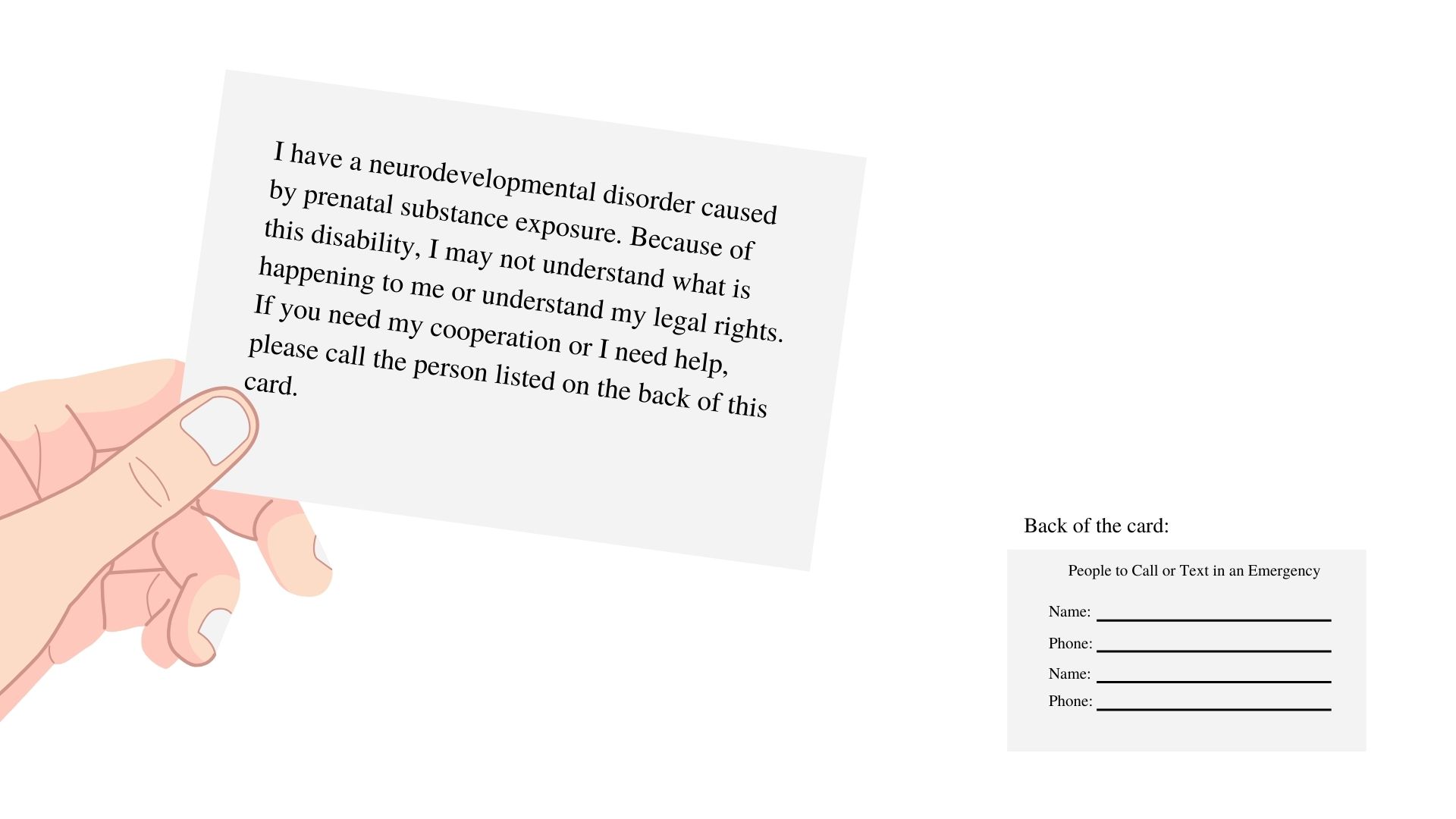
- Consider having your child carry a card for medical emergencies or interaction with law enforcement
- The card might say, “I have a developmental disability. I may not understand our conversation. If I need help, please call the person listed on the back of this card.”
- Instruct your child to use this if they need help
- If your child has a developmental disability diagnosis, they are entitled to a Medicaid waiver (every state has this, but it may have different names)
- Waiting lists can be long, so consider pursuing this earlier in your child’s life
- This can provide your child with services such as support with employment, housing, respite care, and more
- Here is an example of the process for accessing services for your child with prenatal exposure (exact steps, terminology, etc. may differ from state to state)
- If your child has an IEP, a transition plan should be in place by age 14 and further developed during high school
- The plan should include vocational, residential, and recreational needs
- A vocational rehab case can start at age 16 upon parental request, and can remain open into early adulthood
- This can assist with interest inventories, counseling, job exploration, etc.
- Your child may qualify for Supplemental Security Income after the age of 18 if they have a diagnosed disability before the age of 22
- Consider a financial trustee or guardian to protect your child financially and a special needs trust fund or an ABLE account if it is apparent that your child will not be able to live independently
- Supporting-Success-for-Adults-with-FASD.pdf – Create environments for success, daily routines, relationships and community involvement for teens and adults with FASD and other prenatal exposures
- Your child may need you or another trusted adult to serve as their “external brain”
- Find Tips for Adults with FASD
- Download a PDF of the Strategies to Support Transitioning into Adulthood
- Download Tipsheet: Understanding Inappropriate Sexual Behaviors
- Download Tipsheet: Internet Safety