

This article is brought to you through the generous support of our partner, the Jockey Being Family Foundation®. They share our vision of providing education and support to strengthen families.
The natural exuberance of childhood often means that young kids usually feel free and safe to interact with strangers with smiles and waves. They tend toward curiosity, openness, and trust. You’ve seen it in the grocery store – a little cutie in the seat of a grocery cart waving hello to every passing stranger. They have not yet processed the idea of “stranger danger” that parents and caregivers will teach in the coming years. However, what do you do with a child who is too friendly or trusting with any adult around them? What if they are old enough to understand healthy degrees of affection but cannot seem to practice it? The risks of indiscriminate affection can be scary for parents and caregivers.
What is Indiscriminate Affection?
When your child approaches and interacts with other adults around them at the same level of familiarity as their interactions with you or other primary adults, you may be observing indiscriminate affection.
Securely attached children show a range of affection, attention, and connection with the adults they encounter daily. They usually reserve the most personal affection for their primary adults, like sitting on Mom’s lap or hugging Grandpa. They also hold themselves back a bit from strangers or acquaintances.
This range of affectionate displays is unique to each child and within each family. Some kids are naturally more reserved, so hugs or kisses, even with Mom and Dad, are rare. Other kids are exuberantly open, and their circle of safe people to hug is wider.
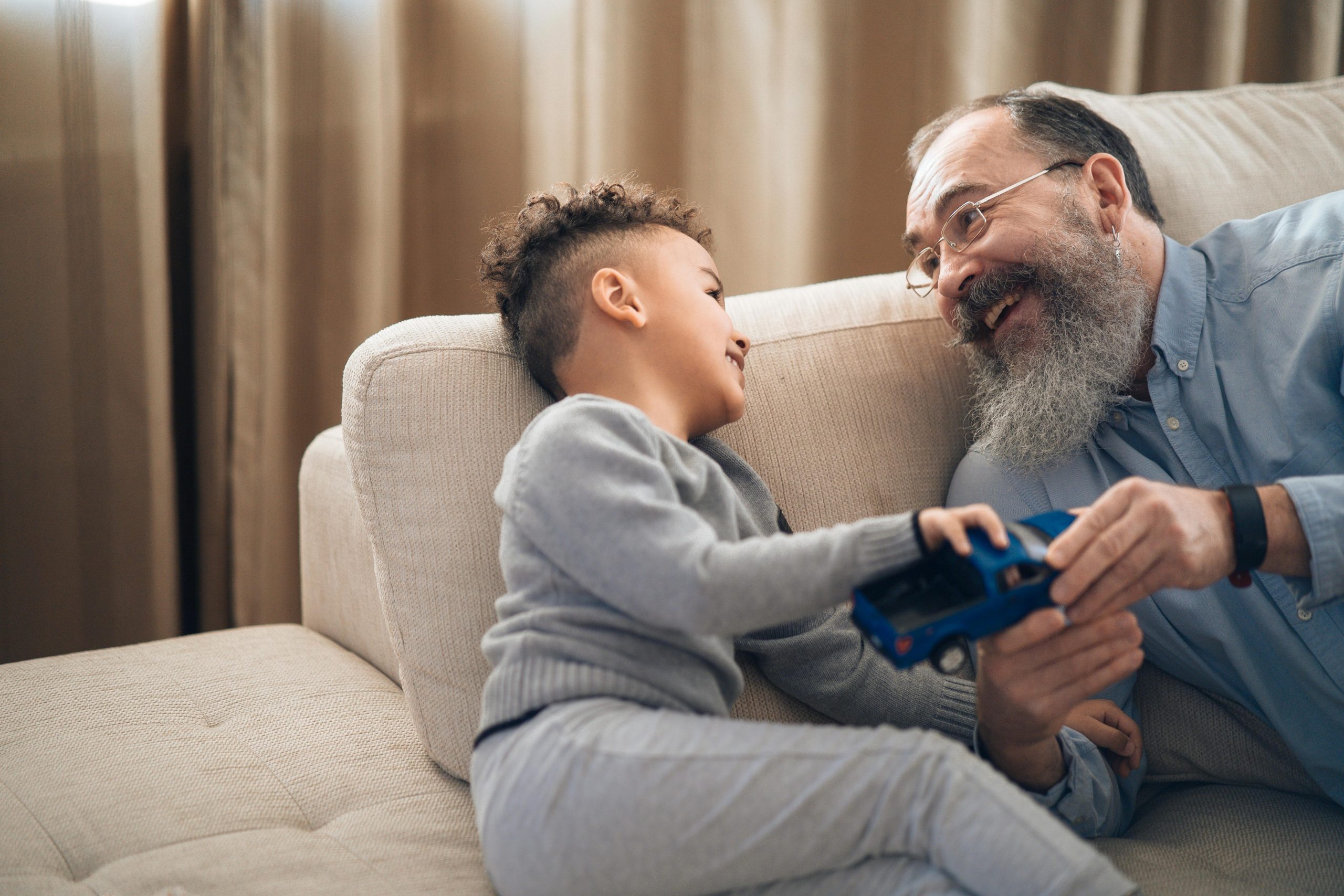
Consider your own inner circle of family or friends. You share parts of your life with these folks quite differently than with someone you see once a month at the market. After coffee, you hug your best friend but shake hands with your kitchen reno contractor. We develop these people skills from experiences over time. We may have also seen them modeled by family members, and we’ve adapted our behavior to the culture around us.
Signs of Indiscriminate Affection
Families in our adoptive, foster, or kinship spaces may feel concerned about indiscriminate affection for many reasons. Your child who has experienced trauma might not have seen enough examples of healthy relationships or had positive life experiences that helped them learn appropriate or safe boundaries with adults outside the family. Children impacted by multiple placements or institutional living may not have formed secure attachments with one primary caregiver. Kids affected by prenatal substance exposure or neurodiversity may struggle to grasp the value of healthy boundaries or issues of safe personal space. They may also struggle to learn impulse control, cause and effect, or have memory challenges.
These signs or behaviors can clue you into a child’s struggle to learn and practice healthy boundaries for expressing affection.
- Accepting and seeking hugs and other physical affection from strangers
- Struggling to respect other people’s personal space
- Accepting help, comfort, and soothing from any available adult, even when injured or scared
- Looking for anyone to meet their physical needs (to help them cross the street, tie their shoes, zip their coat, etc.)
- Appearing to have no fear or hesitation about approaching strangers in public
- Being overly curious or open to interacting with strangers
When raising a particularly outgoing child or when this child is new to your home, the signs of indiscriminate affection might be more challenging to parse out. However, as you take time to get to know this child, you should be able to figure out if they understand safe boundaries.
Understanding Prenatal Exposure to Alcohol and Drugs
Teaching Safe Boundaries for Affection and Interaction
The good news is that your child or grandchild can learn how to get their needs for physical affection met through careful, intentional connection with you, their primary caregiver. Through consistent, predictable care, you can help them form a secure attachment that re-works their foundational understanding of relationships.
Here are a few practical ideas for forming secure attachments. Be patient while implementing these tips because re-learning safe boundaries and attachments will take time and repetition.
1. Establish consistency and predictability.
Creating structure and routine that your child can count on is one obvious way to communicate that you are their safe adult. Work on building consistent nighttime routines, mealtimes, and family time to create a sense of anchoring in your safe space. When kids have previously experienced chaos or erratic care, their brains and bodies need the comfort of familiarity and closeness to feel secure. Your commitment to a predictable environment assures them that “home” is safe, and they can trust you to meet their needs.
2. Use visual aids.
When a child struggles to understand the concept of safe personal space (theirs and others), you can use a hula hoop to provide a concrete illustration. If you don’t have a hula hoop, tape a circle about the size of a hula hoop on the floor.
Stand in the hoop and talk about “personal bubbles.” Explain that everyone has a space that feels comfortable and a space that feels “too close.” Play with this idea by inviting them into the hoop and discussing how that feels. Make sure each of you shares what you are experiencing.
Then, try standing back-to-back in the hoop, on opposite sides, outside the hoop, and other varying distances from the circle to explore how those spaces feel. Try a few games with the circles or hoops, like a “Mother May I?” game. You can also teach permission and consent using these hoop games. Repeat the game as your child needs refreshers or new levels of understanding.
3. Act it out.
Once you’ve observed your child’s boundaries (or lack thereof), create a few scenarios to act out together. Focus on how to help them practice pulling their bubble a little closer.
For example, write a scene about going to the mall and seeing Mrs. Smith. Talk about your family’s relationship with Mrs. Smith. Is it close enough to warrant a hug or a simple “Hi, Mrs. Smith” from you? From your child?
Then, try another scenario with a different level of relationship and closeness.
Discuss things like:
- how those scenarios feel to each of you
- similarities and differences between the two connections
- questions they can ask themself when they face these in real life
Raising Capable Kids – a FREE course
4. Prepare scripts.
Many kids impacted by exposure to drugs or alcohol during pregnancy or trauma in their early years struggle with impulsivity. You can help your child manage the impulse to seek physical affection from others by writing short sentences to help them think first. You can even laminate them on an index card so they carry them daily.
Practice the scripts together and encourage them to say them to themselves when figuring out their boundaries. Here are a few to get you started.
- When I see a stranger, what should I do? Plot out one or two simple steps, such as checking with you to gain permission to talk to them.
- When is it ok to give hugs to others? “When I say it’s ok and when they say it’s ok.”
- Is this a safe person to talk to? Teach them to check their “gut” or check with you (or another safe adult) first.
- Am I too close? Remind them to think about their hula hoop or taped circle to help them decide whether to make their bubble bigger.
- Can I hug you? Can I sit on your lap? Teach your child to ask permission for – and give consent for! – physical touch from others.

These scripts might feel uncomfortable and awkward for both of you at first. But when you practice together, they will learn to ask them internally and manage their impulses. Again, be patient with yourselves as you practice these together. Change them up as your child develops skills and language for their experiences.
Increase Your Supervision and Connection
It’s easy to feel fearful for a child who is too friendly or affectionate with strangers or acquaintances. While it might be tempting to establish narrow, rigid boundaries and keep this child close by your side, it’s also not always realistic. Indeed, your supervision should increase when you notice your child doesn’t yet have safe boundaries. But you also don’t want to create a fearful child who cannot navigate safely through life.
When you are helping a child overcome indiscriminate affection, consider temporarily limiting their time outside of your supervision. Use that season to increase your connections and establish a strong attachment. Then, when you are sure they are learning safe boundaries, loosen up on that tight supervision slowly and carefully while maintaining your connection.
Teaching balanced, reasonable boundaries takes time, patience, and trust. You can set this child up for success when they understand that safe personal boundaries are healthy for all relationships.
Image Credits: Anna Shvets; Mikhail Nilov; Yan Krukau
Add Your Comment